Art Website Not Selling? 7 Things Blocking Your Sales
You launched the website. The photos are good, the colours are right, and you told everyone. Then... nothing. A few visits, some likes on the Instagram post announcing it, and not one order.
So you decide you need more people looking. More posting, more reels, maybe some ads.
That's usually the wrong fix. If your art website is not selling, the first question isn't "how do I get more visitors?" It's "what's happening to the visitors I've already got?"
A website is a tool, not a shop assistant
Having canvas and brushes doesn't mean a painting appears. Having a website doesn't mean sales appear either.
Most artist websites are built like a portfolio: lovely to look at, and set up to be looked at. But looking and buying are two different jobs. A buyer needs to find a piece, see it properly, know the price, know what happens next and pay without thinking about it. Every unclear step is a place she leaves. She doesn't email to ask. She closes the tab.
When we review student websites, the art is almost never the problem. Two things come up again and again.
The first is putting everything and the kitchen sink on there. Every style, every series, every product, in the hope of appealing to as many people as possible. It has the opposite effect. When a site tries to speak to everyone, nobody feels it was made for them.
The second is messaging that isn't clear. When I land on an artist's website, I want to know within three to seven seconds:
- Who is this?
- What do they do?
- Why should I care?
- What makes it special?
If your homepage doesn't answer those straight away, most people won't scroll down to find out.
First, know what "normal" looks like
This bit takes the panic out of it.
You'll often see 2 to 3% quoted as a good conversion rate for an online shop. That's mostly lower-priced things: clothes, candles, phone cases. Art costs more and people take longer to decide, so the average artist website converts somewhere between 0.5% and 1%.
In other words, out of every 100 visitors, 99 or more leave without buying. That's normal. It doesn't mean your website is broken.
Now the maths. Say you want £3,000 a month and your pieces sell for about £500. That's six sales.
- At 0.5% conversion you need 1,200 visitors a month
- At 1% you need 600
Same art, same prices. Moving from 0.5% to 1% halves the traffic you need. That's the beauty of understanding your numbers and knowing what's normal. Otherwise, you can end up fixing the wrong problem.
So if you have fewer than 100 visitors, your first job is to get as much free traffic through to your store as possible. Then you can decide whether your site conversion needs improving.
The 7 things blocking your sales
1. It's built on a laptop and bought on a phone
Around 78% of visits to online shops now come from phones, but phones convert at less than half the rate of desktops (about 1.8% against 3.9%). The gap is friction: tiny text, slow images, menus that hide the shop.
I see this time and time again. A student comes to us because her sales have dropped, and when we look at her website on a phone, there it is: a button sitting over the checkout, so nobody can actually pay. She had no idea, because she'd only ever checked it on her laptop. It's the kind of thing you stop seeing on your own site, and it takes someone else's eyes to spot it.
You built your site at a desk. Your buyer is on the sofa at 9pm. Open your website on your phone, pretend you've never seen it, and try to buy something. Time it.
2. The price is hidden
Lots of artists leave prices off originals, or write "price on request", because it feels more gallery-like or invites a conversation. But the truth is, you're making it difficult for people to buy from you.
In Artsy's collector survey, 95% of collectors said a listed price matters when buying online, and a missing price was the biggest single thing stopping them buying. A gallery has someone in the room to ask. Your website doesn't. So please stop.
And whilst we're on the topic, you don't need a portfolio and a shop. They should do the same thing: show the work and let people buy it.
3. Available work is hard to find
If the shop is three clicks deep, people give up. Get someone from your homepage to available work in one tap.
And don't take your sold work down. I see artists do this all the time. Leave it there, clearly marked as sold. It shows people that others buy from you, and seeing that a piece they loved has already gone gives them a little nudge not to miss the next one. Sprinkle the sold pieces through your shop rather than lumping them together, with a few more available pieces near the top and a few more sold ones further down.
4. The checkout springs a surprise
About 70% of online baskets are abandoned before payment, closer to 80% on phones. The most common reason is a cost that only appears at the end, usually delivery.
If framing, delivery or tax is added at checkout, say so on the product page, or build it into the price. A buyer who sees £450 and then £495 at checkout feels caught out, even though she'd have happily paid £495 if she'd known.
5. Nothing says "why this piece?"
A title, a size and a price isn't a reason to buy. She wants to know what it's like to live with: what inspired it, what it does to a room, what it looks like up close.
Rewrite your five best-selling product descriptions around the feeling the piece gives someone, not the materials. I go into how to find those words in How to Find Buyers for Your Art.
6. Nobody can picture the size
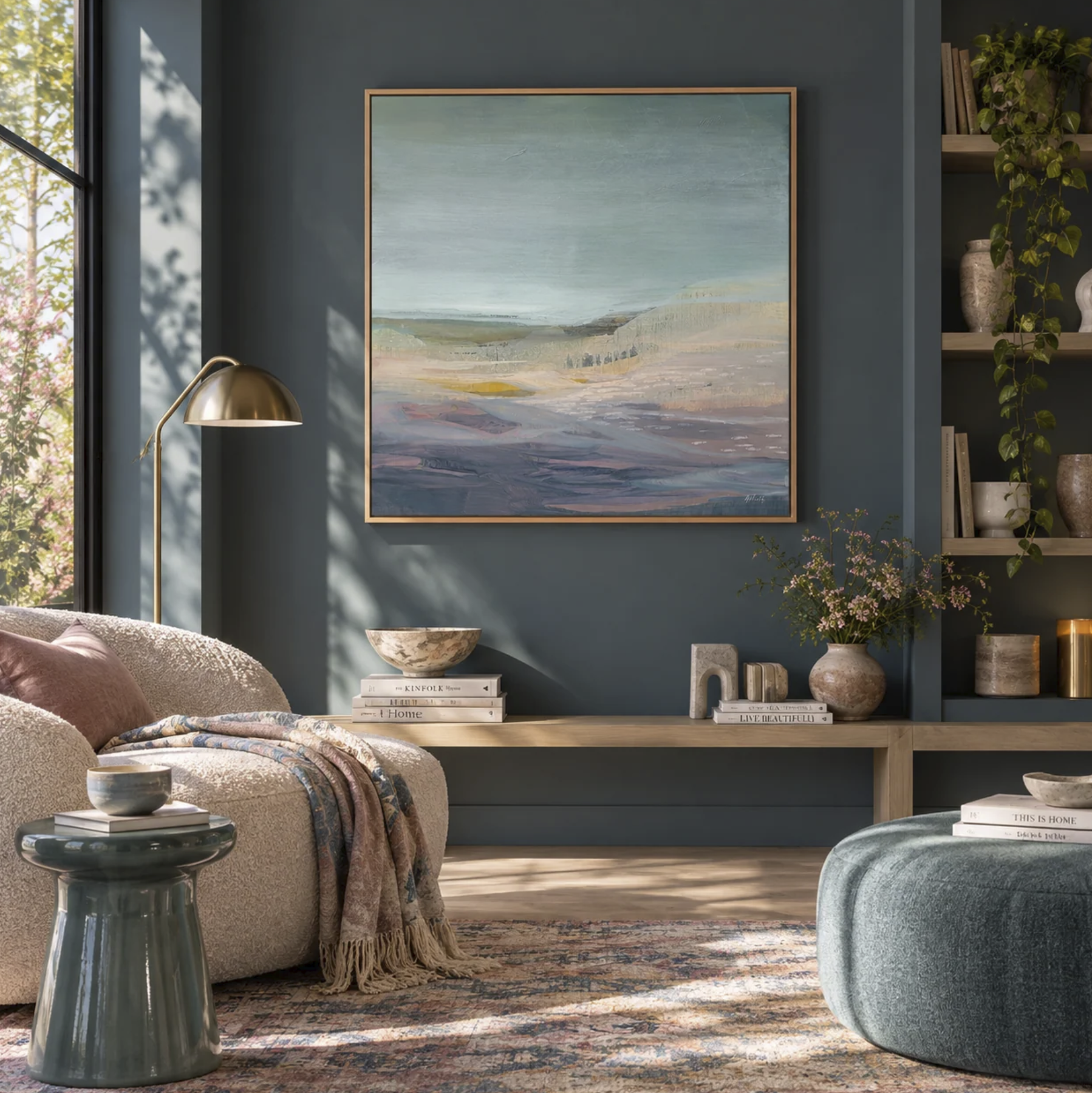
"120 × 120cm" means nothing to most people. Show the piece over a sofa or a sideboard so they can see it in their own home. A room setting like the one above does that in a second.
7. There's no reason to trust you
It's a big purchase from someone they've never met. A short bio with your face, images of you scattered throughout the website so they know there's a real person behind the brand, customer reviews and testimonials, clear shipping and returns policies, and easy-to-find contact details are just a few of the things that build trust.
Get the Web Fix pdf, free
If you don't have it yet, I also have a free PDF called Web Fix. It shows you a few more simple fixes you can make on your website to help increase your sales conversion.
And if you want someone to look at your website properly, every artist in Studio to Sold gets a full website review with video feedback: what's working, what isn't, what to fix and how to fix it. Alongside complete instructions on building the full customer journey from discovery right through to sales.
Then, once your site is converting it's time to think about traffic
Once your website converts, every visitor is worth more, and that's when ads start to make sense. Paying for traffic to a website that leaks sales is pouring water into a bucket with a hole in it. You can pour all you like. It won't stay.
So fix the path first. Then send people down it, and always organic traffic first. Paid traffic only amplifies what's working. It doesn't fix what isn't.
It's rarely the art. It's nearly always the bit between someone loving it, connecting with it, understanding its value and paying for it.
A website doesn't sell your art. A great website that's set up to turn interest into buyers... does.